
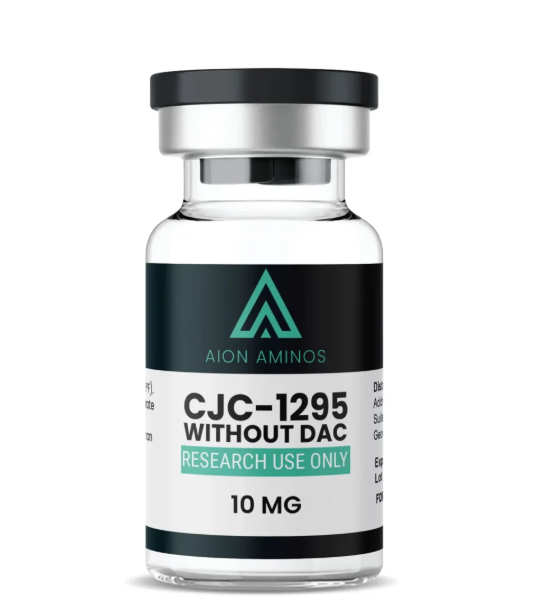

Unlike some newer research peptides that exist almost entirely within animal studies, CJC 1295 No DAC is a growth hormone-releasing hormone analog that has actually been examined in published human research, which makes it something of an exception in this space worth understanding accurately.
A study published in the Journal of Clinical Endocrinology and Metabolism examined a related long-acting version of this compound administered to healthy adult volunteers under closely controlled, placebo-blinded conditions. That clinical endocrinology research study data reported sustained increases in growth hormone and IGF-I levels following subcutaneous administration, findings that came out of a formally designed clinical research trial rather than an animal model, which is genuinely rare territory for a compound in this general category.
The version without the drug affinity complex, commonly labeled “no DAC,” behaves differently from its longer-acting counterpart, primarily because it lacks the chemical modification that extends the other version’s activity in the body over a period of days. This shorter acting profile makes it a useful tool specifically for research settings studying acute growth hormone pulsatility since it produces a brief, well-defined signal rather than a sustained one.
The full picture from the peer reviewed hormone journal article is more nuanced than a single headline finding might suggest, since the study was specifically designed to characterize pharmacokinetics and safety in a research trial context, under close medical supervision, rather than to establish a basis for unsupervised use outside that setting. Even compounds with legitimate published human data still require this kind of careful contextual reading.
It’s worth being clear that despite this existing clinical research, this compound has not received FDA approval as a prescription therapeutic, and products sold commercially are generally labeled strictly for laboratory research use, not for human administration outside of a formal, medically supervised trial.
The trial itself was structured in two phases, with researchers first testing a series of ascending single doses before moving on to repeated dosing over several weeks, all under close medical monitoring at dedicated investigational sites. That kind of staged design, moving carefully from a single exposure to repeated administration only after safety data had been reviewed, is standard practice in legitimate clinical research and stands in sharp contrast to how compounds in this category are sometimes discussed in less careful online spaces.
Follow-up work examining the same general class of compound has also looked at how growth hormone gets released in pulses rather than as a steady stream, since natural physiological signaling tends to happen in bursts rather than a continuous trickle. Researchers found that pulsatile secretion patterns persisted even during ongoing stimulation, which added useful nuance to understanding how these compounds interact with the body’s existing hormonal rhythms rather than simply overriding them entirely.
Researchers working with growth hormone releasing hormone analogs benefit from understanding this distinction clearly, since the existence of published clinical data doesn’t equate to regulatory approval or an established safety profile suitable for use outside a controlled research environment. Reading the primary literature directly, including the full methodology and not just a summarized abstract, remains the most reliable way to understand exactly what has and hasn’t actually been demonstrated.
It also helps to remember that the version without the drug affinity complex has a meaningfully different pharmacokinetic profile from its longer-acting counterpart, with a half-life measured in minutes rather than days. That shorter window changes what kind of research questions it’s actually suited to answering, since a brief, well-defined pulse of activity lends itself to studying acute physiological responses in a way that a sustained-release version simply isn’t designed for. Keeping that distinction straight matters for anyone comparing findings across studies that used one version versus the other.